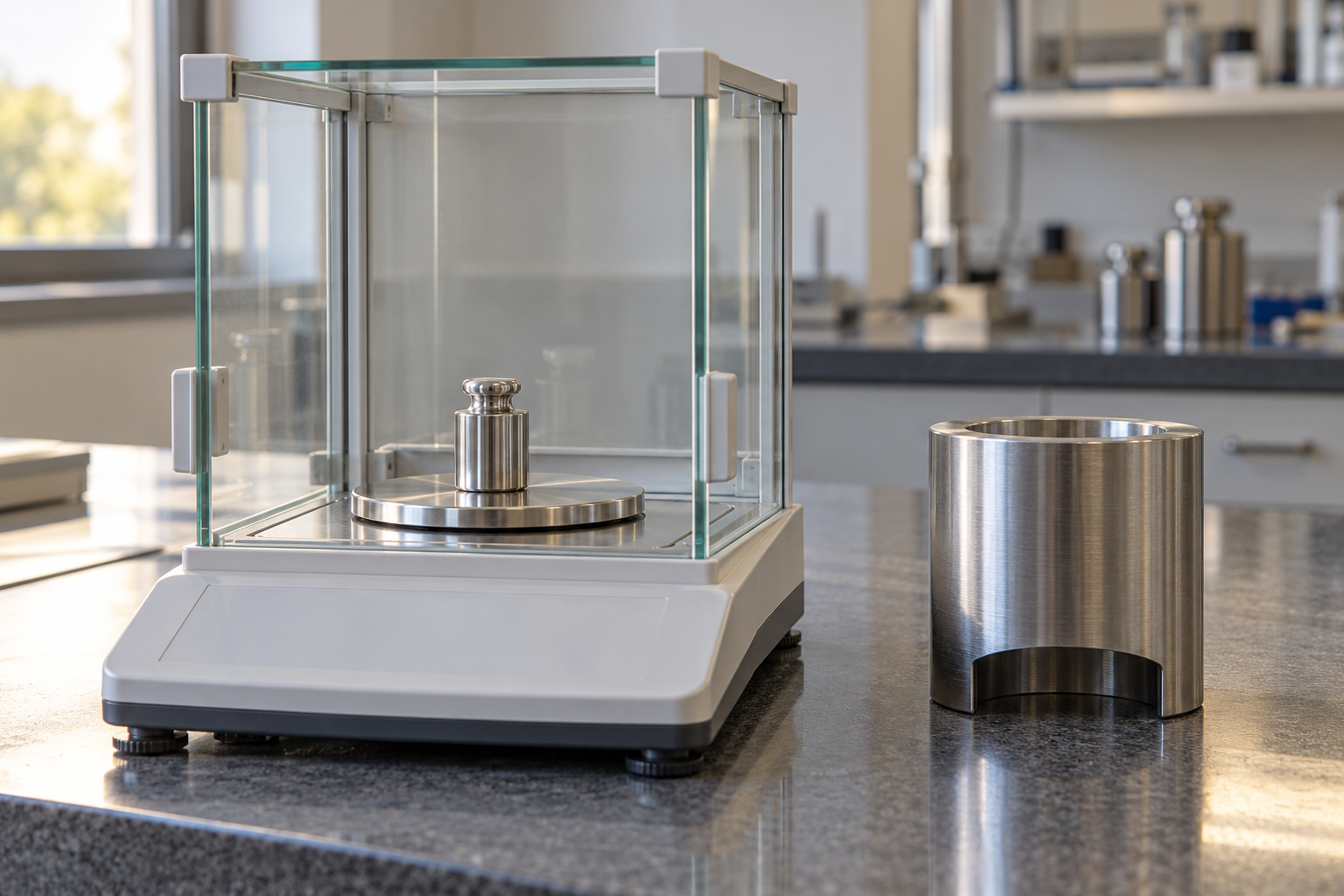
In 1978, three researchers at the National Bureau of Standards compared two stainless-steel objects that weighed about 17 grams apiece. One was solid and compact; the other was hollow and occupied much more space. They first compared the objects inside an evacuated canister, then weighed them in air. The difference between those comparisons revealed something the balance was also measuring: the density of the air around its pan. The objects had not gained or lost steel between weighings. Their different volumes had changed how strongly the air held them up. Koch, Davis and Bower’s original experiment remains a clean way to see an effect that is usually hidden inside a number on a display.
The effect is buoyancy. An object in air pushes aside a volume of air equal to its outside volume. That displaced air pushes upward on the object. The more space the object occupies, the greater the upward force, provided the surrounding air has the same density. A balance responds to the resulting downward force. Its screen may report grams because the instrument has been calibrated to express that force as a mass reading, but the air is still in the comparison. A large, light-looking body and a compact metal weight can have the same true mass and give different indications in the same room.
This is not a quirk of an unusually sensitive machine. It is the same physical principle that lets a boat float, expressed at the tiny scale relevant to mass measurement. In ordinary air, the effect is easy to miss because air is much less dense than steel. It grows visible when an object has a large volume for its mass, when two compared objects differ greatly in volume, or when the allowed error is exceptionally small. NIST’s air-buoyancy procedure makes this a question of required accuracy and measurement uncertainty, rather than a correction that every user must calculate for every weighing.
The space inside the comparison
The NBS pair was designed to make volume matter while keeping mass nearly the same. The hollow object’s overall density was roughly 0.5 grams per cubic centimetre; the solid one’s was about 8. Both were steel, but the empty space enclosed by the hollow one counted in its external displacement. To establish the small difference in their actual masses without relying on an air-buoyancy calculation, the researchers placed each in turn inside an evacuated canister and weighed the canister on a laboratory balance. In the subsequent air comparison, the volume difference turned the balance into a measure of the air’s density. Across their reported trials, the air densities found from the artifacts were close to those calculated from local pressure, temperature and humidity. This was a particular experimental check, with its own uncertainty; it does not mean every balance can infer air density from two arbitrary objects. The experimental paper describes both the setup and its limits.
The size of the force is simple to picture. At a reference air density of 1.2 kilograms per cubic metre, one cubic centimetre of air has a mass of about 1.2 milligrams. If two equal-mass objects displace volumes differing by ten cubic centimetres, the difference in their buoyant forces is equivalent to the weight of about 12 milligrams at that air density. That is an illustration, not a promised error in a particular reading: the actual comparison also involves the reference weight, the local air and the balance’s calibration. The reference density is the one used in OIML’s specification for standard weights, not a claim that every laboratory has that air density.
The reference matters because a balance is never simply observing an isolated specimen. It has been adjusted or calibrated against standards, whether those are external weights or part of an instrument’s calibration process. Those standards displace air too. If a sample and its reference have the same mass and nearly the same external volume, much of their buoyancy is common to both. If their volumes differ, the difference survives the comparison. Zeroing the display removes the current offset; it cannot tell the instrument the unknown sample’s volume. Repeating the weighing in unchanged air can make a reading precise while leaving the same buoyancy difference in every repetition.
Metrologists also distinguish true mass from conventional mass. The latter is a defined way to report weight values in air using a reference density of 8,000 kilograms per cubic metre, air density of 1.2 kilograms per cubic metre and equilibrium at 20 °C. These values make certificates and weight comparisons compatible; they are not descriptions of every actual room or object. OIML R 111-1 gives those reference conditions, while NIST’s procedure shows how a high-accuracy result is calculated from the measured conditions and the densities or volumes of the objects compared. A displayed value is therefore best read in the context of the balance’s calibration and the kind of mass result the job requires.
Air is a changing material
The surrounding air does not hold a fixed density. Pressure, temperature and water-vapour content affect how much mass occupies a given volume. At the same pressure and temperature, adding water vapour tends to lower air density because water molecules are lighter than the main molecules they replace in the mixture. The detailed CIPM-2007 equation for moist air includes pressure, temperature, water-vapour fraction and properties of the gas mixture. It is a tool for precision work, not a reason to treat a household humidity reading as a mass correction on its own.
This explains why pressure changes can matter even if the object and instrument appear undisturbed. The volume displaced by a rigid specimen may be essentially the same from one measurement to the next, while the mass of air in that volume changes. A porous material or flexible container adds another complication: its volume, water content or both may respond to the environment. The first question is thus what actually changed. Was it the air pushing up, the sample itself, or another force acting on the pan?
For high-accuracy mass comparisons, NIST instructs operators to record temperature, pressure and relative humidity near the balance at the beginning and end of the measurement. Those observations support an air-density calculation. The method also needs the test object’s and reference standard’s volumes or densities. If conditions shift substantially during a series, waiting for stability or accounting for the change may be necessary. The resulting correction is judged against the measurement’s tolerance and uncertainty. A small correction can sometimes remain unapplied but still belong in the uncertainty budget; a high-accuracy determination needs it addressed explicitly.
When the reading moves for another reason
Air buoyancy is a steady upward force for a given object in a stable atmosphere. Moving air can instead make the reading wander. A vent, a hand moving near the pan or an open draft shield may push on the object or pan directly. A warmer object can create its own local airflow as nearby air rises. NIST’s guidance on weighing operations treats air currents and lack of thermal equilibrium as distinct sources of error, and recommends allowing the test object, standards, balance and nearby air to reach similar temperatures. Calculating a better buoyancy correction will not quiet a draft.
Humidity has two other roles that are easy to mistake for buoyancy. Very dry conditions can make electrostatic effects troublesome for precision weighing; an electrically charged object may experience a force unrelated to its mass or displaced air. Moisture can also condense on, evaporate from or be absorbed by a specimen, changing the material actually on the pan. NIST notes both electrostatic trouble under dry conditions and the need to watch for frost or condensation when weights arrive from a different environment. Those mechanisms call for handling and equilibration, not merely a new air-density number. The same NIST practice guide places cleanliness, handling and environmental control alongside the choice of weighing method.
A useful weighing sequence therefore starts before the arithmetic. Let the object and reference settle near the balance. Keep the draft shield closed during a precision reading and avoid warming a weight with bare fingers. Look for drift and repeatability. If the task requires high accuracy, record the local air conditions and know the volume or density of what is being compared; then calculate or bound buoyancy against the uncertainty the result can tolerate. If the task does not require that level of accuracy, the same physics still applies, but its contribution may be too small to change the decision.
The NBS researchers made the invisible contribution visible by choosing two shapes that differed sharply in the amount of air they displaced. The broader lesson is quieter. A balance reports a number produced in a particular room, against a particular reference, under particular conditions. Understanding the air around the pan tells us when that number needs another step before it can stand for the mass we meant to measure.
A thought worth keeping?