Set two clocks to the same second and leave them on a shelf. Tomorrow, one may lead the other. Nothing has happened to its hands except that they have followed a slightly faster stream of ticks. Setting a clock answers what time is it now? Keeping it answers a different question: how long should each next second last?
A clock needs some repeatable event to count, whether a swinging pendulum or an electrical oscillation. It also needs a way to relate that event's rate to the second it claims to display. The frequency reference may be a carefully adjusted part inside the clock, a signal consulted from elsewhere, or both. Without a trustworthy rate, a perfect setting is only briefly perfect.
The beat beneath the display
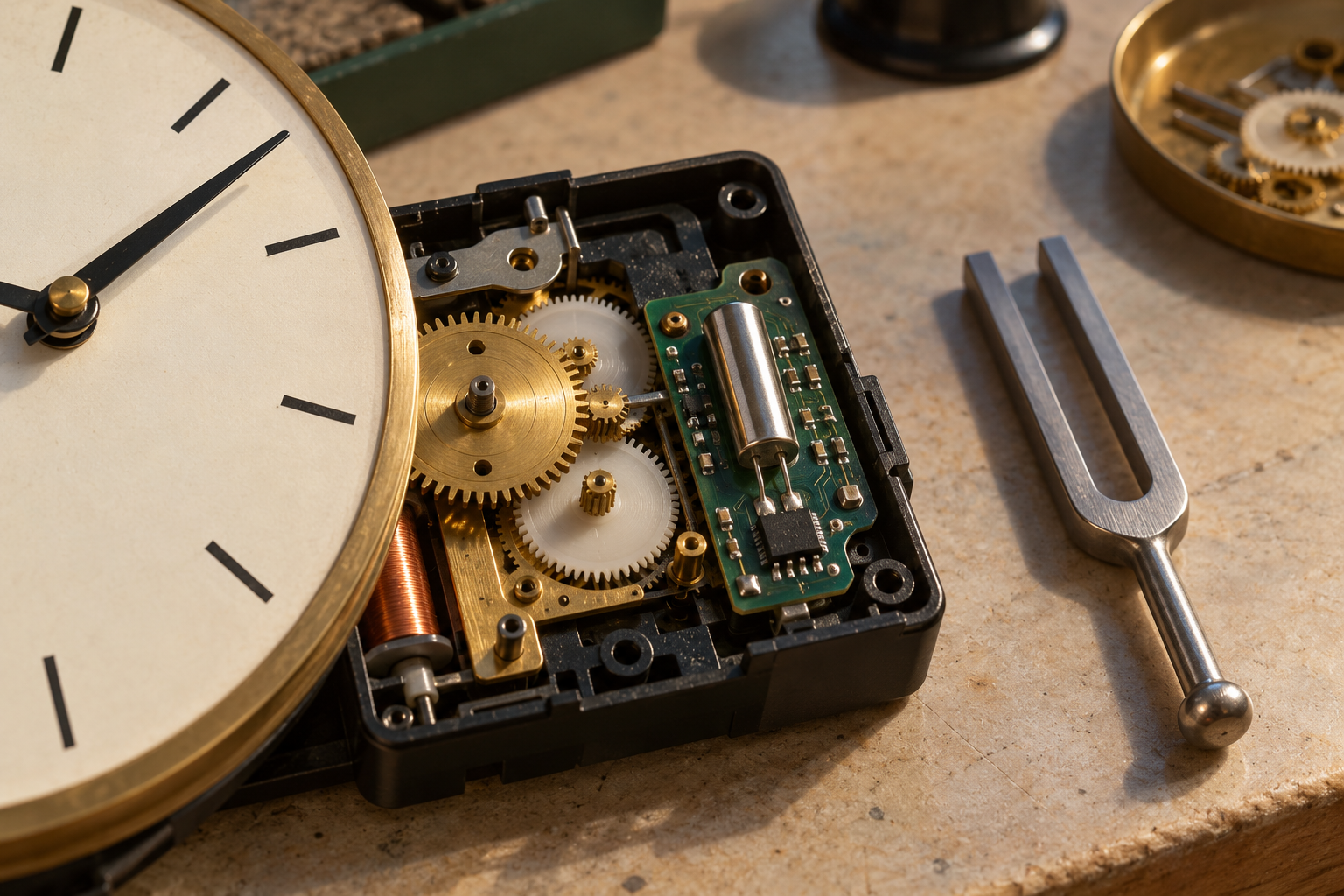
The minute hand is the last link in a chain. In a common quartz clock, a crystal vibrates in an electronic circuit; the circuit's pulses are counted and divided to make slower ticks. NIST's explanation of clock mechanisms gives 32,768 cycles per second as a usual watch frequency. Count 32,768 nominal cycles and the clock advances one nominal second. A digital display may hide the motion, but it still depends on a time base.
Quartz is useful because it makes a compact resonator with a repeatable response to electrical stimulation. The crystal changes shape slightly when voltage is applied, and an oscillator circuit sustains its motion. Its cut and dimensions help determine the frequency. As NIST's quartz-oscillator reference explains, temperature, pressure, vibration and aging can shift that frequency. Dividing a nominal 32,768-hertz signal into one-hertz ticks does not remove an error in the signal's rate. If the source runs fast, the divided ticks do too.
Even instruments built to measure time have a local beat. NIST calls an instrument's internal oscillator its time base. A counter may report a neat row of digits, but their meaning depends on the spacing of its reference pulses. A higher number of displayed decimal places cannot rescue an uncalibrated time base.
Three ways to be wrong
Imagine a clock set one minute ahead, whose oscillator then runs at exactly the intended rate. It remains one minute ahead. That is an error in its starting time, not in the length of its seconds. Set another clock exactly right but let its oscillator run ten parts per million fast. If that rate offset stays constant, it gains about 0.864 second over a day. The arithmetic is simply 86,400 seconds multiplied by 0.000010. One reading cannot tell you which problem you have; you need a later comparison.
There is a third question: does the oscillator keep the same rate? A frequency can be consistently too high yet quite steady. Conversely, its average rate over a long interval may be close to right while its short-interval rate wanders. NIST's definition of stability draws this distinction explicitly. Stability describes how well an oscillator holds its frequency over a stated interval; it does not say whether that frequency is correct. The interval matters. An oscillator that behaves well for a minute may show a different weakness over a month.
These are separate faults with different remedies. Moving the hands or changing the displayed hour corrects a time offset. Adjusting or disciplining the oscillator addresses rate. Reducing temperature changes or choosing a different oscillator may improve stability. A clock can need more than one of these at once, which is why the ordinary instruction to “make it accurate” is too vague to diagnose it.
The second that gives the beat meaning
What should the rate be measured against? The International Bureau of Weights and Measures' account of the SI second fixes the frequency of a particular transition in unperturbed caesium-133 at 9,192,631,770 hertz. In effect, the second is the duration of that many periods of the corresponding radiation. This is a definition of the unit, not a description of what ticks inside every wall clock.
Laboratories realize that definition with instruments whose electrical oscillations are related to the atomic transition. They must account for conditions that shift an actual measurement away from the ideal. The BIPM document is careful about uncertainty: a physical realization approaches the definition with a known limit, rather than producing a magically error-free second. Ordinary clocks use a more practical local oscillator, and its rate can be measured or adjusted against a better reference through a chain of comparisons.
That distinction explains why a frequency reference is more than a label printed on a component. “32,768 Hz” states the intended rate of a watch crystal; it does not prove that a particular crystal maintains exactly that rate at every temperature for years. The reference supplies a way to test the claim. The clock can then use its local oscillator between tests, with whatever uncertainty that interval allows.
Between one time signal and the next
A radio-controlled clock gives a clear view of the division of labor. It receives a time code that can tell it the current hour and date, then relies on its own mechanism to advance until another signal arrives. NIST distinguishes a time code from a time base: one carries enough information to synchronize the time of day; the other provides recurring pulses inside the instrument. Receiving the right time once does not guarantee the next day's reading.
In NIST's study of radio-controlled clock accuracy, the source signal, propagation delay, synchronization error and error accumulated between synchronizations all enter the result. A fresh update can remove an accumulated display offset. Repeated comparisons can also reveal a persistent rate error if the clock is designed to use them that way. The received signal is useful, but the intervening hours still belong to the local oscillator.
Even a seemingly dependable external beat needs scrutiny. Some electric clocks have counted cycles of the power grid. In the United States that grid operates at a nominal 60 hertz, yet a 2017 study of power-line timekeeping found that phase error could accumulate and had to be deliberately corrected to keep synchronous clocks on time. “Usually close to 60 cycles each second” and “the right total number of cycles by November” are different promises. The study concerns particular US power systems and their correction practice, not every grid or every clock plugged into a wall.
To judge a clock, compare it with a reference now and again after a known interval. A fixed offset tells you about its setting. An offset that grows steadily points to a rate difference. An offset that grows unevenly asks you to look at the oscillator and its surroundings. The face gives the time; the trail of comparisons tells you whether its seconds can be trusted.
A thought worth keeping?