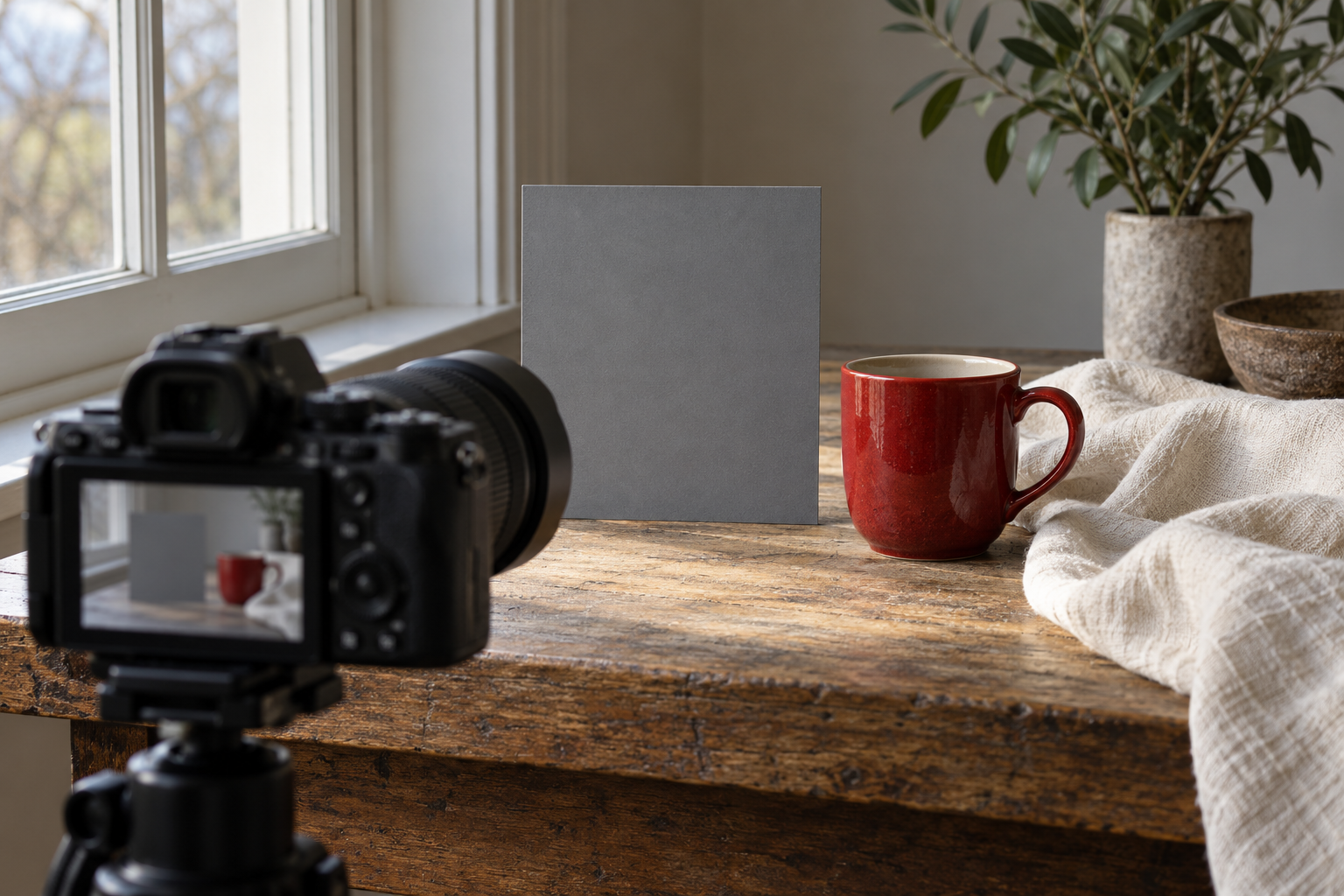
Imagine photographing a cream cloth beside a red cup under a warm lamp. In the file, the cloth looks yellow. Which part of that yellow belongs to the cloth, and which part came from the lamp? The camera recorded light reflected from the surface; the image alone does not arrive with a label separating the two. White balance is the decision about how that light should be rendered. A neutral reference card, placed beside the cup under the same lamp, gives the camera one fact it could not infer securely from the objects: this patch has no intended red, green or blue cast.
That fact is small, but it is powerful. If a surface known to be neutral produces unequal responses in a camera's colour channels, the imbalance tells the processing system something about the light and the sensor's response to it. The system can change the channels' relative gains so that the patch renders neutral. A camera study by Casper Find Andersen and Jon Yngve Hardeberg describes this white-balancing step as equalising camera RGB values from a neutral patch before the harder work of translating camera colours into standard colour values. The reference supplies a starting point. It does not give the camera a complete description of every object in the photograph.
A known surface changes the question
Without a reference, automatic white balance has to estimate the colour of the illumination from the scene itself. That is a difficult inverse problem: a frame full of red fabric might be a red room under neutral light, or a less red room under redder light. Algorithms can make useful assumptions about the colours common in pictures. In a 2007 colour-imaging study, Weihua Xiong and colleagues tested a method for identifying grey surfaces to improve an automatic estimate of the illuminant. Their work sits alongside the simpler “grey world” idea that the average scene colour can stand in for neutral. These approaches can work well in suitable scenes; their assumptions are precisely what a deliberate reference card replaces for a particular shot.
The camera still needs the reference to be a genuine neutral under the conditions that matter. “Grey” describes appearance and brightness, but a grey object is not automatically a reliable colour standard. The European Color Initiative's digital-photography compendium warns that some papers contain optical brighteners and that a card sold for exposure metering need not be sufficiently neutral for colour balancing. Eighteen per cent reflectance is a statement about how much light a card returns, not a guarantee that it returns every visible wavelength in the same proportion. A purpose-made neutral target is useful because its response is controlled. A convenient sheet of office paper may be white to the eye while behaving differently under another lamp.
Placement matters just as much as the card's material. Nikon's D850 preset-white-balance instructions specify a grey or white reference under the lighting that will be used for the final photograph. A card by a window is a poor witness for a subject under a ceiling lamp. Move the card into the subject's light, and the measurement addresses the right question. The manual also warns that a reading may fail when the reference is too dark or too bright. If a white target is overexposed, the camera may have lost the channel differences the measurement needs; if it is buried in noise, the differences are less dependable. The aim is a clear reading from a neutral surface, not the brightest possible rectangle.
This is why a reference shot can be more useful than merely selecting a menu item labelled “daylight” or entering a colour-temperature number. A preset names an expected kind of light. The card records how the actual light reaches the camera at that place and moment. Nikon's colour-temperature controls themselves separate an amber–blue adjustment from a green–magenta one and caution that choosing a temperature alone may give poor results under flash or fluorescent light. A number in kelvins can be a useful starting instruction; it is a thinner account of a real lamp than a measurement in the scene.
The card is a first anchor, not a full portrait
What happens after the grey patch is neutral? The red cup does not become a calibrated red simply because the card has stopped looking yellow. Camera colour channels have different spectral sensitivities from human vision, and actual surfaces reflect intricate mixtures of wavelengths. In an experiment with a colour chart under halogen, metal-halide and daylight-fluorescent lamps, Francisco Martínez-Verdú and colleagues measured how camera responses depended on spectral sensitivity and illumination. Andersen and Hardeberg's later camera-characterisation experiment used neutral patches and numerous coloured patches to test the translation from the camera's RGB values to standard colour coordinates. The distinction is practical: white balance sets a neutral point, while a colour profile addresses the wider relationship between the camera's signals and rendered colours.
There is a deeper limit to any three-channel measurement. Different spectra can produce the same camera RGB response, and camera and human observers may disagree about when two colours match. Manuel Leonhardt and Harald Brendel tested such critical spectra using measured camera sensitivities, surface reflectances and illuminants including LEDs. Their result does not imply that photographs are generally untrustworthy. It means that a neutral card cannot recover spectral detail the sensor never distinguished. Two lamps can bring a neutral patch to a similar white balance while making a particular coloured fabric look different. Where faithful product, art or scientific colour matters, controlled illumination and a more complete colour-characterisation workflow are consequential.
The same-light rule also has a spatial limit. Consider a portrait beside a window with a warm table lamp on the other side of the face. A card at one position measures the mixture of light there. One set of global colour gains then applies across regions lit by different mixtures. In a 2008 mixed-light study, Eugene Hsu and colleagues showed a photograph in which conventional global balance left a warm cast in one area and pushed another area blue. Their proposed method estimated the local mixture of two user-specified light types, under explicit assumptions about the scene's materials. That research is evidence of a limitation and a possible specialised remedy, not a promise that any camera can recover the original colour of every object from one mixed-light image.
There is also a difference between a measurement and a final visual choice. A white-balance reference says how to render a known neutral patch under a chosen light. It does not decide how much warmth a photograph should retain to convey the light in a room. Elaine Jin, Yixuan Wang and Wentao Liu tested viewers' responses to adjusted white balance in seven scenes captured under daylight, fluorescent and tungsten lighting. Across their controlled tests, neutral aims were close to the preferred positions, yet tolerance for shifts varied with scene content and light source; the tungsten scenes allowed more yellowward change before judged quality fell as sharply. The result belongs to those scenes and observers. It supports using neutrality as a defensible reference, while leaving room for a photographer to make a considered rendering of the actual atmosphere.
One format choice affects how late that decision can be made. Adobe's description of raw and DNG processing says the camera's intended white balance can be stored with raw data as a setting for the converter; the raw file can then be rendered with a different balance. A camera-made JPEG has already gone through the camera's colour processing. Changing its apparent balance later is possible, but it works on that rendered result rather than returning to the original sensor data. Neither format turns a bad reference into a good one, and neither can reconstruct colour information lost to clipping or an unsuitable light source.
The plain grey card earns its place because it narrows an otherwise slippery question. Under the same light as the subject, at a usable exposure, it gives the camera a surface whose colour is known before the photograph is interpreted. That single statement can make a whole series of images more consistent. It also makes the remaining decisions easier to see: where the light changes across a scene, how coloured materials respond to it, and whether a technically neutral result tells the truth the photographer wants the image to tell.
A thought worth keeping?