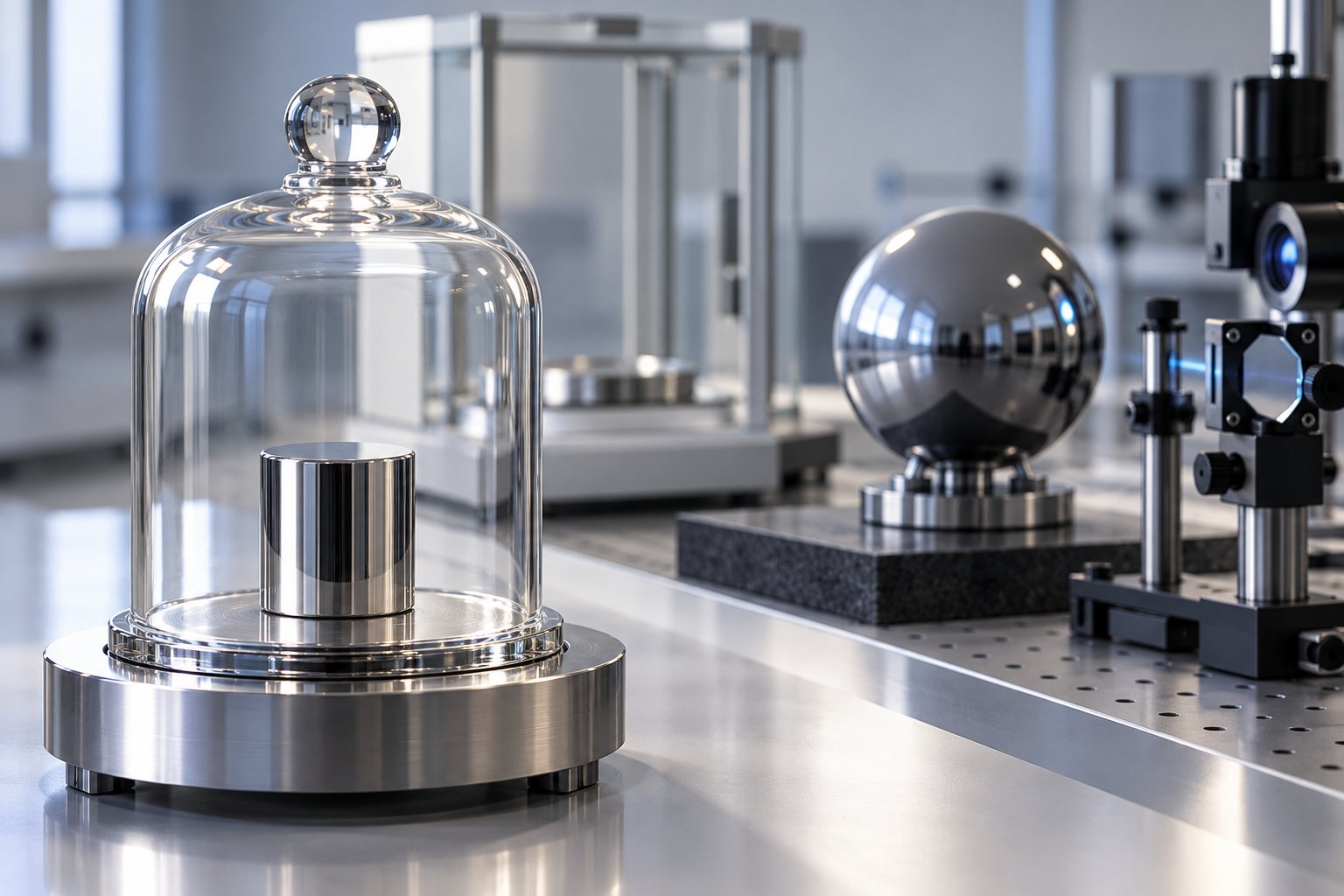
For 130 years, a small metal cylinder near Paris had an extraordinary job. The International Prototype of the Kilogram was about 39 millimetres high and 39 millimetres across, made of platinum and iridium. Its mass was the kilogram. National standards had to be compared, through a guarded chain of copies and measurements, with that one object. The Bureau International des Poids et Mesures still conserves it. Since 20 May 2019, though, the cylinder has been a mass to measure rather than the thing that defines mass.
The change addressed a problem more subtle than a damaged weight. Copies of the prototype changed in mass relative to it. In a 1993 recommendation, the international committee recorded significant relative drifts, then said the comparisons could not settle whether the prototype, its copies, or both had changed. One cannot put the definition on a different scale to check it while the definition is the object on the first scale. The familiar claim that the cylinder simply “lost” a particular number of micrograms goes further than those comparisons permit.
In 2018, representatives of the international measurement system voted to define the kilogram through an exact value of the Planck constant, a quantity linking energy and frequency. The resolution took effect on 20 May 2019. It fixed the constant at 6.62607015 × 10⁻³⁴ joule seconds; the joule contains kilograms, metres and seconds in its units. With the second and metre defined through other fixed constants, that exact value defines the kilogram without appointing one piece of metal as its master.
It did not make every balance exact. The definition tells a laboratory what a kilogram means; an experiment must still turn it into a reliable measured mass. The international mise en pratique for the kilogram describes ways of doing that, with explicit uncertainty. It also says the change was arranged for continuity: immediately after redefinition, the old prototype's mass was still 1 kg within a relative standard uncertainty of 1 × 10⁻⁸. The cylinder did not physically jump when the rule changed.
Two ways to build a kilogram
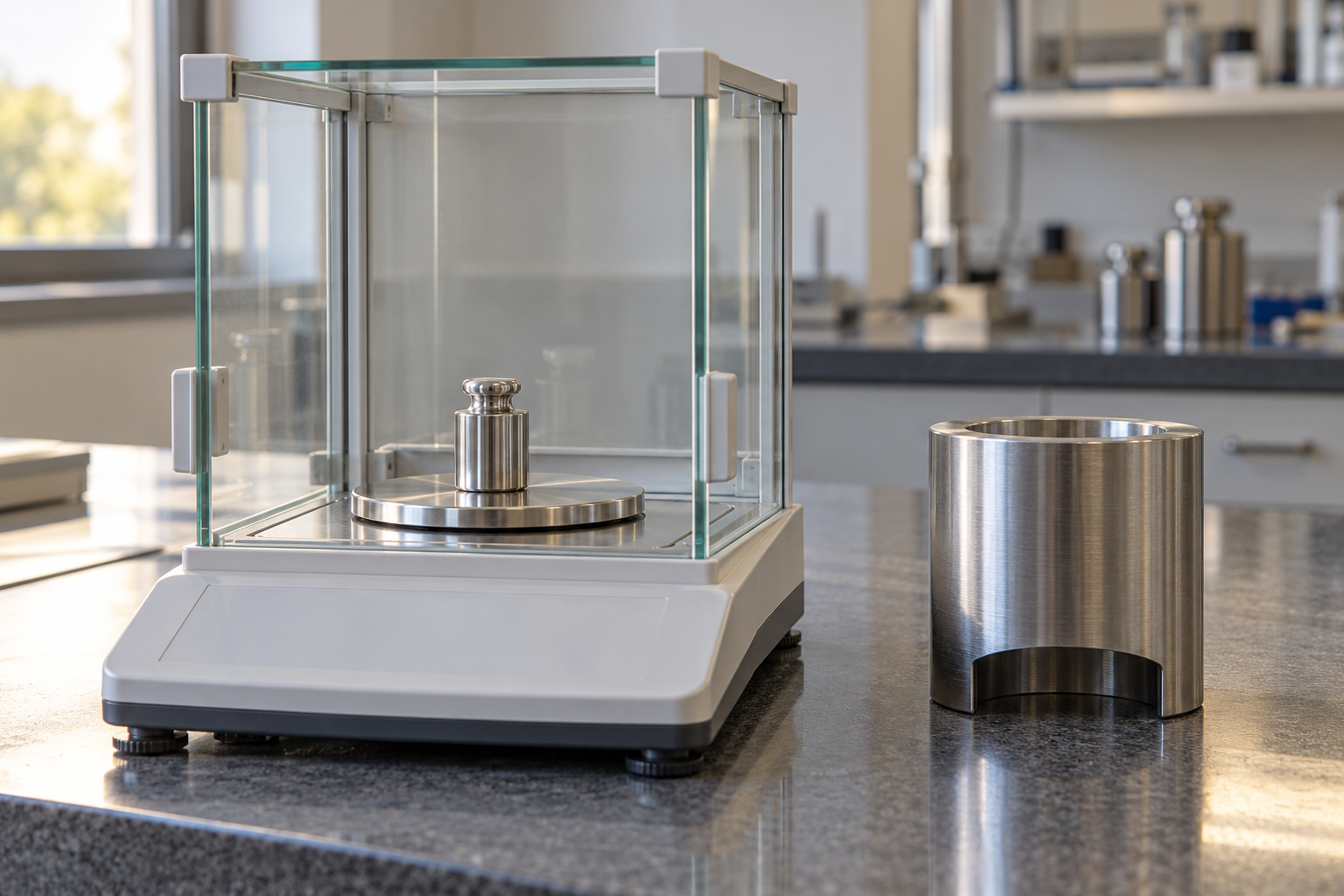
One route uses a Kibble balance. In its weighing mode, current through a coil produces a magnetic force that balances the pull of gravity on a mass. In its moving mode, the coil moves through the magnetic field and produces a voltage. Combining the two measurements cancels the hard-to-know product of magnetic field strength and coil length. The laboratory measures current, voltage, motion and local gravity, with electrical quantities linked to quantum standards and thus to the fixed Planck constant. The BIPM's practical account sets out the two modes; NIST's description gives a view of the apparatus and the measurements behind them. The balance does not make the weight disappear. It gives that physical weight a measured mass with a documented uncertainty.
A second route begins with a near-perfect crystal sphere enriched in silicon-28. Researchers measure the sphere's volume and the spacing of atoms in its crystal lattice. Those measurements help determine how many atoms are in it; the relation between atomic mass and the Planck constant links the count to kilograms. The BIPM account of X-ray crystal density describes why the sphere's surface layers, volume, lattice spacing and isotope composition must be known. A silicon sphere is still a carefully kept object, but its mass is determined through a reproducible method rather than declared exact by custody.
Neither experiment gets to skip the awkward details. The Kibble balance must measure the local pull of gravity, which is not identical everywhere, as well as the coil's speed and the electrical quantities. The sphere's measured diameter must be related to the crystal beneath its thin surface layers, and the real crystal is not made of silicon-28 alone. Laboratories report uncertainty for these measurements because an exact defining constant does not make the observations exact. The international practical guide treats that accounting as part of realizing the unit, not as an afterthought.
These routes are powerful precisely because they are different. A laboratory can compare results from independent methods, find disagreements and improve the measurement. No shop scale needs a Kibble balance beside it. NIST describes a chain in which a kilogram mass is measured in the balance's protected vacuum, compared with a transfer mass that can be brought into air, then used to calibrate other masses and scales. Those comparisons eventually reach instruments used by inspectors and businesses. Each link has work to do: the definition alone cannot tell whether a particular scale is clean, level or calibrated.
The system's continuing work is visible in a small 2026 consensus adjustment. Because national realization experiments still differ slightly, the international mass committee uses a consensus value for disseminating the kilogram. From March 2026, that value assigned the old prototype a mass of 1 kg minus 12 micrograms, with a standard uncertainty of 20 micrograms, on the scale defined after 2019. This was a five-microgram adjustment from the 2023 consensus value. It changed a calibration reference, not the exact Planck constant or the meaning of the unit. The committee limited the step to keep the disseminated scale stable while experiments improve.
The old cylinder remains useful. It can now be weighed against a unit that does not depend on it, and its history can be studied with a genuine outside reference. A kilogram in an ordinary laboratory still travels through physical masses, comparison records and measured uncertainties. What moved out of the vault in 2019 was the authority to declare one object perfect. The care required to make one mass agree with another stayed in the laboratory.
A thought worth keeping?